
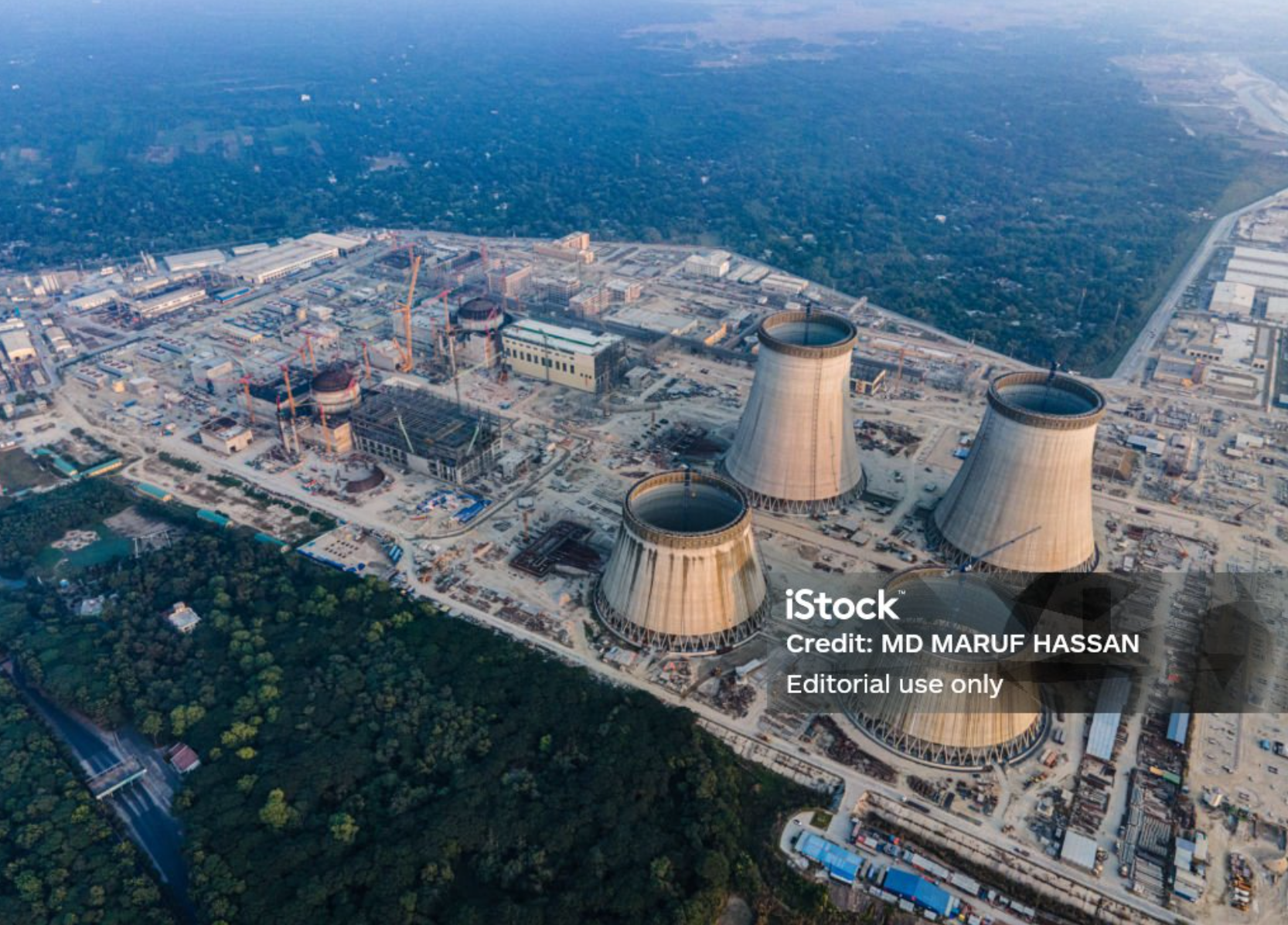
Unit 1 of Bangladesh’s Rooppur Nuclear Power Plant has successfully finished loading all 163 nuclear fuel assemblies, marking a crucial milestone in the country’s nuclear power development journey.
Undertaken on a turnkey basis by Russia’s Rosatom State Atomic Energy Corporation, the project comprises two VVER-1200 Generation III+ reactors with an installed capacity of 1,200 MW each, bringing the total installed capacity to 2,400 MW. Signed in 2015 at a contract value of 12.65 billion US dollars, the project will make Bangladesh the third South Asian nation with commercial nuclear power, following India and Pakistan.
The fuel loading operation kicked off on April 28, 2026, and was fully accomplished in mid-May in strict accordance with approved core loading plans and stringent nuclear safety protocols.
The entire procedure was executed by Rosatom and its subsidiary Atomstroyexport, complying fully with initial core loading procedures, technical specifications and international nuclear safety standards. The project has now entered the subsequent construction phase, including the installation of upper reactor units, connection of core instrumentation systems and extensive commissioning tests. The reactor is poised to reach the minimum controlled power level, followed by gradual power escalation, grid connection and trial commercial operation.
Timeline Outlook
Unit 1 is expected to enter the physical startup phase soon, with initial power generation targeted between June and August 2026, starting with low-power supply before ramping up to full capacity. Fuel loading for Unit 2 is also set to commence shortly, and the full operation of both units is scheduled to be achieved by the end of 2027.
Construction Timeline Review
The overall project contract was signed in 2015. Construction of Unit 1 broke ground in November 2017, while Unit 2 started construction in July 2018. The first batch of nuclear fuel arrived at the construction site in October 2023. Prior milestones included the completion of hot and cold functional tests and turbine installation, and the plant obtained the operating license issued by Bangladesh Atomic Energy Regulatory Authority on April 16, 2026.
Although the project faced certain delays caused by the COVID-19 pandemic and global supply chain disruptions, overall construction has remained steady. Despite the adjusted commissioning timeline to 2026-2027, the project is advancing steadily toward completion.
Fuel Management Arrangements
Russia will supply nuclear fuel for initial loading and subsequent refueling operations. Spent nuclear fuel will be sent back to Russia for professional disposal, ensuring full-lifecycle safety and controllability.
Main Equipment Suppliers: Russia-led Turnkey Nuclear Engineering
As a typical EPC turnkey project, the Rooppur Nuclear Power Plant adopts Russian core technologies with mainstream equipment supplied by Rosatom and its affiliates, demonstrating Russia’s strong comprehensive strength in nuclear power technology integration.
Nuclear Island Core Equipment (Fully Russian-manufactured)
Key nuclear island facilities including reactor pressure vessels (RPV), steam generators, main circulation pumps and core structural components are manufactured and supplied by Atomenergomash (AEM Technologies) and its subsidiaries such as Atommash and AEM-Special Steels. Advanced safety facilities including core catchers are also produced by Rosatom subsidiaries.
TVEL Fuel Company holds the exclusive supply right for all 163 initial fuel assemblies and follow-up refueling fuels, taking charge of full-lifecycle nuclear fuel services.
Conventional Island and Auxiliary Systems
Turbines, generators, condensers and other conventional island equipment are designed and manufactured by Russia’s Power Machines headquartered in Saint Petersburg. Heat exchangers, industrial pumps and other auxiliary equipment are mainly sourced from Atomenergomash affiliates including ZiO-Podolsk.
Critical safety modules such as Passive Heat Removal Systems (PHRS) are provided by Russian enterprises including Ural Chemical Engineering Plant, while liquid radioactive waste treatment facilities are supplied by Sverdniikhimmash under Atomenergomash. Electrical systems, control systems and relay protection systems are jointly delivered by Russian suppliers and cooperative partners.
Non-Russian Participating Parties
All four cooling towers and pumping stations are constructed by India’s Paharpur Cooling Towers. Under the tripartite cooperation framework among Russia, India and Bangladesh established in 2018, more Indian enterprises have taken part in civil engineering construction, raw material supply and non-nuclear island installation works. Local Bangladeshi contractors are responsible for subcontracting civil works and auxiliary facility construction.
Rosatom is tasked with delivering over 4000 tons of equipment covering more than 50 categories, most of which are shipped to Bangladesh via sea transportation. All nuclear island core facilities and key safety systems adopt authentic Russian VVER-1200 technology that meets the world’s top-tier nuclear safety criteria.
Project Profile and Far-reaching Strategic Significance
Scale & Technical Advantages
Equipped with two VVER-1200 Generation III+ pressurized water reactors with a net power output of 1200 MW per unit, the plant is designed for a 60-year operational lifespan, extendable up to 80 years. It is fitted with advanced passive safety systems including core catchers and passive heat removal devices.
Investment & Geographic Location
With a total investment of approximately 12.65 billion US dollars mainly backed by Russian export credit financing, this is Bangladesh’s largest infrastructure project to date. The power station is situated in Pabna District, around 160 kilometers northwest of Dhaka, along the banks of the Padma River.
Strategic Implications
Upon full commissioning, the nuclear power plant is projected to satisfy 10% to 20% of Bangladesh’s total electricity demand. It will effectively ease domestic power shortages, reduce reliance on imported fossil fuels and accelerate the nation’s low-carbon energy transition, ushering in a new era of clean energy development for Bangladesh.
The steady advancement of the Rooppur Nuclear Power Plant not only delivers reliable clean power resources to Bangladesh, but also sets an outstanding benchmark for international nuclear energy cooperation. In the years ahead, this landmark power complex will keep powering Bangladesh’s sustained economic prosperity and social development.
Leave a Reply