
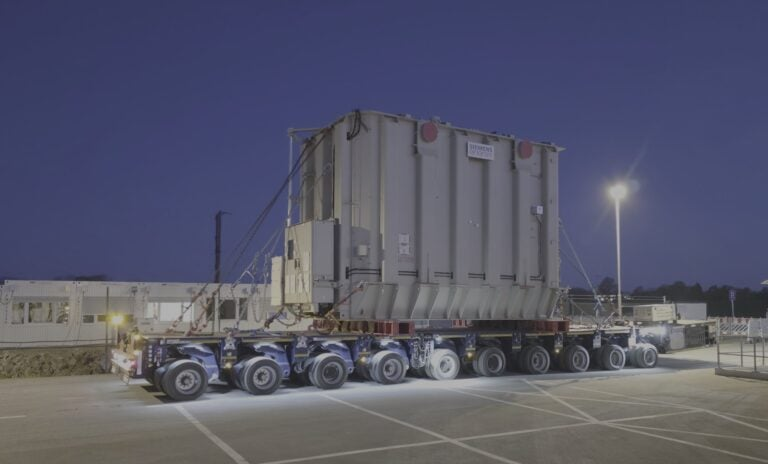
Source: NeuConnect
A new landmark moment has arrived in the history of European energy interconnection. On May 11, 2026, Siemens Energy completed the delivery of all 14 giant transformers for the NeuConnect project, injecting strong momentum into the first direct energy “highway” connecting the UK and Germany. This milestone not only highlights the outstanding execution capability of the engineering team but also signals the project is advancing steadily toward its 2028 commissioning target, ushering in a new era of clean, efficient and mutually beneficial cross-border power connectivity.
As the first direct high-voltage direct current (HVDC) subsea cable interconnection project between the United Kingdom and Germany, NeuConnect is envisioned to facilitate renewable energy integration, enhance energy security and lower electricity prices.
Project Scale
Boasting a total capacity of 1.4 GW (1400 MW) with bidirectional power transmission capability, the project can meet the daily electricity demand of approximately 1.5 million households.
Technical Highlights
It features a DC voltage of 525 kV, with AC side voltages of 380 kV for Germany and 400 kV for the UK respectively. The total route length is around 725 kilometres, of which the subsea cable segment accounts for over 700 kilometres.
Strategic Route
The interconnection starts from the Isle of Grain Converter Station in Kent, UK, passes through territorial waters of the UK, the Netherlands and Germany, and terminates at the Fedderwarden Converter Station near Wilhelmshaven in Lower Saxony, Germany.
Siemens Energy Transformers: Core Equipment Fully Deployed
Siemens Energy has supplied all 14 giant HVDC converter transformers (7 units for the UK side and 7 for the German side) for the 1.4 GW UK-Germany HVDC interconnection project. As the core critical equipment of converter stations, these transformers enable efficient conversion between alternating current (AC) and direct current (DC), ensuring stable interconnection between the UK and German power grids.
All units are manufactured at Siemens Energy’s plant in Nürnberg, Germany, fully demonstrating the facility’s robust production capacity in the field of HVDC transformers.
Physical Specifications & Transportation Highlights
Each transformer measures approximately 7 metres in length and 5 metres in height, with an ultra-wide footprint and a weight of over 200 tonnes — equivalent to the weight of a passenger train or a large residential building.
The transportation operation was highly challenging: all transformers were first transported by Rhine River barge from the Nürnberg plant to Rotterdam, then delivered to construction sites in both countries via sea freight and road transport respectively.
The 7 transformers for the UK side arrived at the Isle of Grain Converter Station in Kent in early 2026. The final 7th unit for the German side was successfully delivered to the Fedderwarden Converter Station near Wilhelmshaven in May 2026, marking the full completion of the delivery mission. This sophisticated and well-orchestrated heavy logistics solution once again proves Siemens Energy’s professional expertise in delivering large-scale power equipment.
Technical Type & Core Functions
These units are HVDC Converter Transformers specially designed for high-voltage direct current systems, compatible with Siemens Energy’s HVDC Classic and HVDC Plus technologies.
At converter stations, they perform pivotal power conversion tasks: converting AC power from the grid into DC power at the sending end, and converting DC power back to AC power at the receiving end. The design complies with the 525 kV high-voltage DC transmission standard and matches the 400 kV AC voltage level of the UK grid and 380 kV of the German grid.
Adopting the advanced ODAF/OFAF forced oil-circulation air-cooled cooling system, the transformers maintain continuous and efficient heat dissipation under high load conditions, meeting the stringent operational requirements of long-distance subsea cable interconnection projects.
Performance Characteristics
Siemens Energy’s HVDC converter transformers are renowned for high efficiency, low power loss, strong short-circuit withstand capability and superior insulation performance. They are optimally engineered to support bidirectional power flow and balance fluctuations in renewable energy generation.
Per Siemens Energy’s general specifications, such transformers can reach a voltage level of up to ±1100 kV and a single-unit capacity of several hundred MVA. While the specific MVA rating of each unit for the NeuConnect project remains undisclosed, the coordinated operation of the 7 transformers on each side is fully capable of supporting the project’s total transmission capacity of 1.4 GW.
Rapid Construction Progress: Steady Advancement Toward Full Completion
NeuConnect’s construction is progressing at an impressive pace:
Converter Station Buildings:
Converter stations in both countries have reached the designed dimensions of 24 metres in height and 70 metres in width, with exterior cladding works well underway.
Subsea Cable Laying:
Main contractor Prysmian has laid more than 300 kilometres of subsea cables in total. Cable laying in UK waters has been fully completed; construction in Dutch waters is ongoing; the 12-kilometre cable section connecting the North Sea coast to the Fedderwarden Converter Station on the German side is nearing completion.
Arnaud Grévoz, CEO of NeuConnect, commented enthusiastically:
“The delivery of the 14 transformers was an arduous task and represents another major step forward for this vital renewable energy link. With onshore buildings nearing full completion and over 300 kilometres of subsea cables already laid, we are making solid progress and staying firmly on schedule.”
Led by global top-tier investors including Meridiam (France), Allianz Capital Partners (Germany), Kansai Electric Power and Tokyo Electric Power Company (Japan), the NeuConnect project is fully privately financed with a total investment of approximately £2.4 billion / €2.8 billion. Construction kicked off at the UK site in summer 2023 and commenced on the German side in May 2024, with official commercial operation scheduled for 2028.
Leave a Reply