
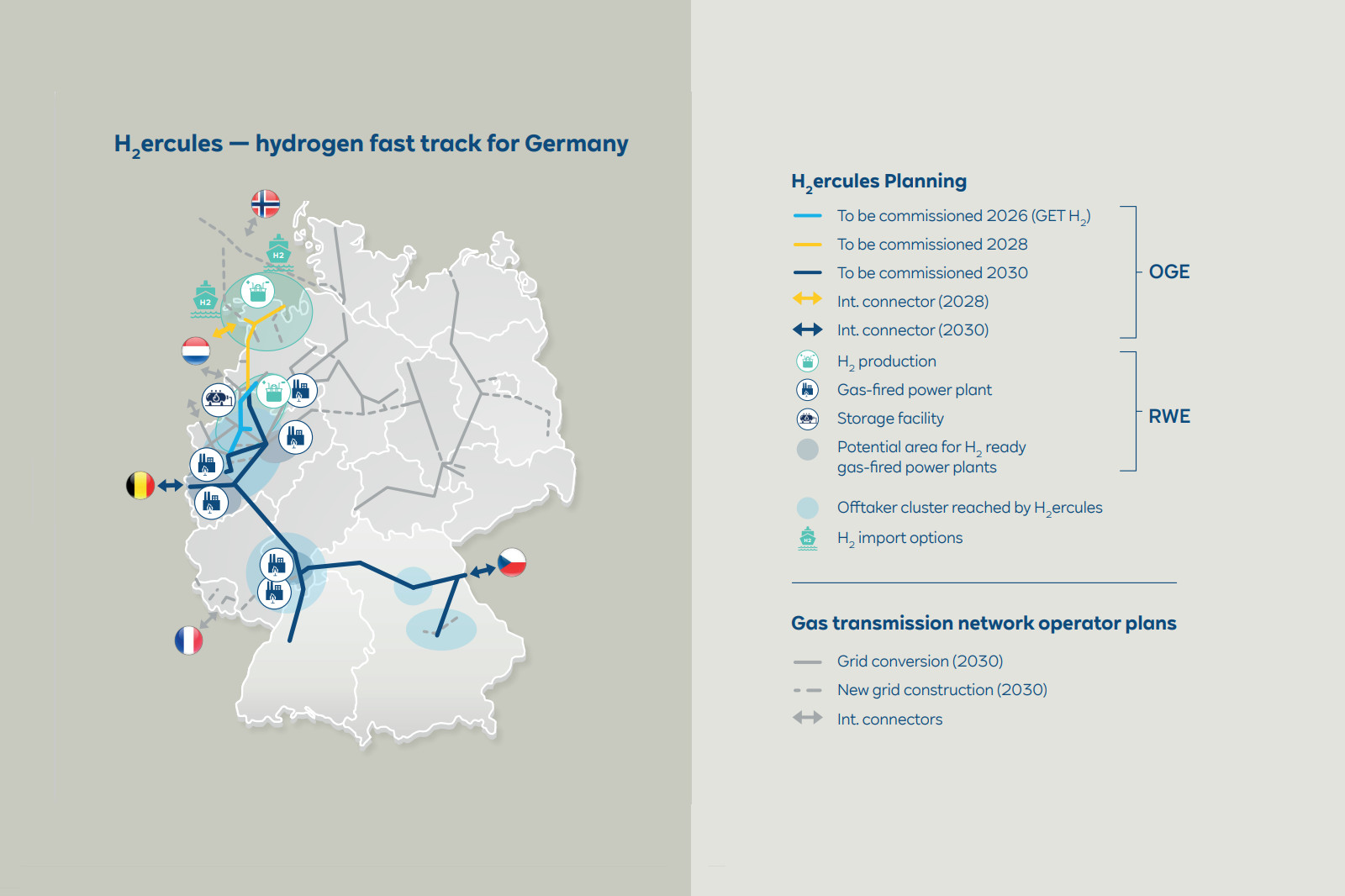
Source: rew
As the flagship core project of the European Hydrogen Backbone, the H2ercules initiative is jointly developed by Germany’s pipeline operator OGE and Gasunie, the national gas network operator of the Netherlands. Serving as a critical “hydrogen artery”, this infrastructure will efficiently transport green hydrogen produced via offshore wind power in the Dutch North Sea to the Ruhr Region, Germany’s industrial heartland, supplying low-carbon, clean energy to industrial giants including thyssenkrupp and large-scale chemical plants.
Classified as an Important Project of Common European Interest (IPCEI), the scheme has secured substantial government subsidies from both Germany and the Netherlands. It is widely regarded as a pivotal initiative for Europe to break free from fossil fuel dependence and advance industrial decarbonization. Beyond being the first commercial demonstration segment of the upcoming thousands-of-kilometers hydrogen corridor network, it sends a clear global signal: the hydrogen era is no longer a distant vision but an accelerating tangible reality.
Major progress was achieved on April 22–23, 2026, with the full removal of cross-border technical barriers, marking the comprehensive transition of the H2ercules project from the planning phase to construction and retrofitting. Key milestones include:
Pipeline Material Compatibility Certification: Completion of hydrogen embrittlement risk assessment for existing cross-border natural gas pipelines to ensure long-term high-pressure hydrogen transportation safety.
Cross-border Pressure Matching Standards: Finalization of unified pressure specification protocols for the Dutch-German section, laying a solid foundation for efficient cross-border hydrogen transmission.
This landmark breakthrough significantly accelerates project delivery and establishes a replicable technical framework for the future large-scale development of hydrogen infrastructure across Europe.
Adopting a cost-effective and feasible strategy dominated by existing pipeline retrofitting supplemented by new pipeline construction, the H2ercules project stands as a landmark demonstration for the European Hydrogen Backbone.
Project Launch & Planning
March 24, 2022: German pipeline operator OGE and energy giant RWE jointly announced the official launch of the H2ercules project.
The initial blueprint planned a roughly 1,500-kilometer hydrogen network, connecting northern Germany’s hydrogen import hubs to major consumption centers in the south.
Core Retrofitting Strategy
The project’s most distinctive feature lies in its high proportion of existing pipeline reuse:
Approximately 75% of the network repurposes legacy natural gas pipelines;
Only seals, valves and compressor units require replacement, eliminating the need for extensive excavation and new pipeline laying;
Construction costs and project timelines are drastically reduced, delivering a low-cost, rapidly deployable model for European hydrogen infrastructure expansion.
Two Core Technical Challenges & Key Breakthroughs
Hydrogen transportation presents two critical technical hurdles:
Hydrogen Embrittlement: The risk of metal cracking and brittleness caused by hydrogen atom penetration into pipeline materials.
Low Density & High Flow Rate Demand: Hydrogen has merely 1/8 the density of natural gas, requiring higher flow velocities to deliver equivalent energy output and imposing stricter operational demands on compression systems.
Through long-term fatigue testing, the project team verified that existing natural gas pipelines can withstand high-pressure hydrogen service without severe hydrogen embrittlement. Meanwhile, new centrifugal compressors have completed testing under simulated cross-border pressure conditions, fully meeting stable high-flow hydrogen transportation requirements.
H2-ready Steel Grades & Key Supply Chain Partners
To guarantee the safety of newly built pipeline sections and critical junction points, the project prioritizes the application of H2-ready steel that meets dedicated hydrogen transportation standards.
Key collaborative suppliers include:
Salzgitter AG and its subsidiary Mannesmann: The primary steel pipe supplier for H2ercules, specializing in the R&D and production of hydrogen-compatible steel materials.
Europipe (a joint venture between Salzgitter and Dillinger): Provider of large-diameter submerged arc welding (SAW) steel pipes for main trunk lines.
Benteler: Supplier of high-precision pipe fittings and connection components.
These leading European steel enterprises form a robust supply chain backbone for the H2ercules project, ensuring the pipeline system integrates high structural strength with exceptional hydrogen resistance.
Cutting-edge Technological Innovation: Solving Hydrogen Embrittlement & Compression Bottlenecks
Core Technical Properties of H2-ready Steel
Developed by Salzgitter, H2-ready steel is a highly optimized low-carbon micro-alloyed steel compliant with API 5L standards, mainly available in L415NB (X60) and L485MB (X70) grades. Its core technical upgrades cover:
Ultra-low sulfur and phosphorus content:
Vacuum degassing technology minimizes sulfur and phosphorus levels, reducing non-metallic inclusions and eliminating structural defects that trigger hydrogen-induced cracking.
Uniform and refined microstructure:
Thermo-Mechanical Controlled Processing (TMCP) generates fine acicular ferrite structures to effectively hinder hydrogen atom diffusion.
Low carbon equivalent with micro-alloying:
Reduced carbon content coupled with niobium, vanadium and titanium additives enhances material toughness and weldability while maintaining high tensile strength.
Critical Performance Indicators
Compliant with NACE TM0284 standards for Hydrogen Induced Cracking (HIC) resistance;
Outstanding resistance to Sulfide Stress Cracking (SSC);
Sustained fracture toughness under hydrogen saturation pressure to prevent brittle failure.
In simple terms, this advanced steel achieves extreme material purity, refined microstructure and reinforced toughness, restricting hydrogen atom infiltration and eliminating long-term hydrogen transmission safety risks.
A Catalyst for Europe’s Hydrogen Transition
The groundbreaking progress of the H2ercules project accelerates Europe’s transition from hydrogen ambition to practical implementation. It unlocks a vital cross-border channel for green hydrogen exports from the Netherlands and industrial decarbonization in Germany’s Ruhr Region, and validates a scalable European development model centered on existing pipeline retrofitting and H2-ready advanced materials. With cross-border technical barriers fully resolved, the project is on track for commercial operation in the coming years and will serve as a replicable benchmark for the expansion of hydrogen backbone networks across the European continent.
As a specialized manufacturer of flanges, pipe fittings and precision connection components, we recognize that the full-scale realization of the hydrogen era relies heavily on high-reliability sealing systems and piping solutions. The stringent technical specifications for valves, seals and precision fittings implemented in the H2ercules project clearly reflect emerging growth opportunities for the flange and piping industry.
GM Piping supplies carbon steel, stainless steel, alloy steel and special-grade flanges, pipes, fittings and valves for hydrogen energy, gas-fired power generation, petrochemical and power industries. Whether supporting rapid material supply for new project construction or maintenance and upgrading services for long-term operational assets, GM Piping delivers professional technical support, stable supply chain solutions and timely global delivery services empowered by our proprietary AI system BANGUO.
Leave a Reply