
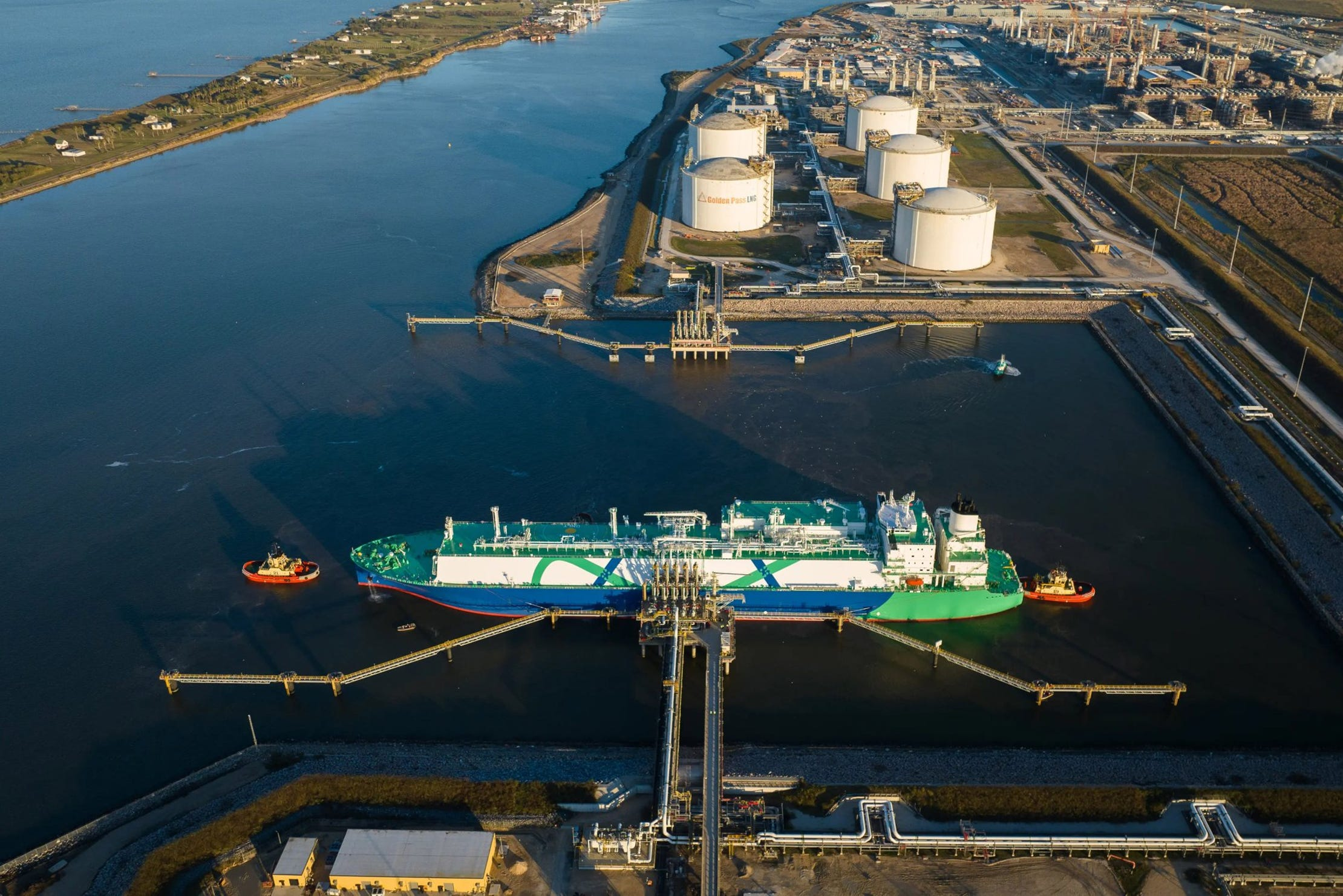
Photo: QATARENERGY
Jointly funded by Qatar Energy (70% equity stake) and ExxonMobil (30% equity stake), the Golden Pass LNG project involves a total investment exceeding 10 billion U.S. dollars. Upon full commissioning, the facility will boast an annual liquefaction capacity of 18.1 million metric tons per annum (MTPA), supported by three dedicated liquefaction trains, each with a designed capacity of approximately 6 million metric tons. The first train successfully achieved initial LNG production on March 30, 2026, while the second and third trains are slated for full commissioning in 2027.
Natural gas supply for the Golden Pass LNG terminal is primarily secured via the Golden Pass Pipeline, operated by Golden Pass Pipeline LLC, an entity jointly owned by Qatar Energy and ExxonMobil with the same 70/30 ownership ratio.
Stretching approximately 70 miles (113 kilometers) from Louisiana to the Sabine Pass terminal in Texas, the main pipeline features a nominal diameter of 42 inches (1.067 meters). Constructed with API 5L carbon steel materials of X70 steel grade (minimum yield strength: 70,000 psi), the pipeline adopts a wall thickness of 0.617 inches (15.67 millimeters) for key sections and is coated with external epoxy anti-corrosion protection. Engineered as a buried high-pressure transmission pipeline, the system fully complies with stringent safety regulations set by FERC and PHMSA. The primary network adopts a single mainline design, with short-distance 24-inch loop pipelines installed in select segments for capacity expansion.
Core Infrastructure Upgrade Measures (FERC Approved in 2016)
Three new compressor stations have been deployed at Milepost 1, Milepost 33 (Orange, Texas), and Milepost 66/69, configured with dual electric and gas-driven systems with a combined output of tens of thousands of horsepower. Five existing interstate pipeline interconnection points have undergone comprehensive bidirectional renovation and upgrading, enabling reversible gas transmission and metering compatibility with major pipeline networks including Tennessee Gas Pipeline, Texas Eastern, and Transco. Short 2.6 to 3-mile 24-inch loop pipelines have been added in targeted sections, alongside supplementary facilities such as mainline isolation valves and pig launchers and receivers.
The site preparation for upgrade construction commenced in 2022, with total upgrade investment surpassing 500 million U.S. dollars. As of April 2026, bidirectional renovation works have been substantially completed, enabling the gradual southward transportation of natural gas from northern production basins to support terminal commissioning and the upcoming maiden LNG loading.
In terms of core liquefaction equipment, the project integrates high-efficiency gas turbines, electric motors, and centrifugal compressors supplied by Siemens Energy as the core drive system.
Surge in U.S. LNG Export Expansion Drives Global Supply Growth
According to the latest forecasts from the U.S. Energy Information Administration (EIA), U.S. LNG export capacity will maintain sustained growth driven by the phased commissioning of multiple large-scale LNG projects by the end of 2027.
Corpus Christi Stage 3
Slated for full commissioning by late 2026, this expansion will raise the site’s total annual capacity to approximately 10 million metric tons. Delivered under EPC contracting by Bechtel Energy, the project relies on pipeline infrastructure operated by Cheniere Corpus Christi Pipeline, L.P., a subsidiary of Cheniere Energy. A 21.5-mile dedicated pipeline connects the terminal to regional interconnected pipeline systems, with supplementary supply from the Whistler Pipeline. The facility deploys Chart Industries’ IPSMR® mid-scale liquefaction technology and power equipment supplied by Baker Hughes.
Port Arthur LNG Phase 1
Featuring two liquefaction trains with a combined annual capacity of 11.7 million metric tons, the project is currently in peak construction, with the first train targeted for initial commercial LNG exports in the first half of 2027. Bechtel Energy serves as the EPC contractor, while Sempra Infrastructure develops dedicated supporting pipelines to deliver Gulf Coast feedgas to the terminal. Core liquefaction train equipment, including Frame 7 gas turbines, is supplied by Baker Hughes, and cryogenic pumps, expanders, and BOG compressors are provided by Elliott Group.
Rio Grande LNG
Partial commissioning scheduled for 2027 will deliver an initial annual output of 10.2 million metric tons. Bechtel Energy undertakes EPC construction, and feedgas transportation is facilitated by the Rio Bravo Pipeline developed by Enbridge. The first three liquefaction trains adopt Air Products’ AP-C3MR™ liquefaction technology, while the fourth and fifth trains integrate refrigerant systems and heat exchanger solutions from Honeywell, with all power systems supplied by Baker Hughes.
Plaquemines LNG
Phase 1 of the project reached full operational capacity in 2025. In March 2026, it secured approval from the U.S. Department of Energy (DOE) for an additional annual export authorization of 3.7 million metric tons (0.5 Bcf/d). Developed via EPC collaboration between Venture Global and KZJV, a joint venture of Kiewit and Zachry, the terminal is connected to interstate gas networks through Venture Global’s proprietary pipeline system, with modular liquefaction core power solutions delivered by Baker Hughes.
Elba Island LNG
In April 2026, the project obtained DOE approval to expand its annual export entitlement by 700,000 metric tons (0.1 Bcf/d). Developed and constructed by IHI E&C as the EPC contractor, the facility leverages Kinder Morgan’s extensive existing pipeline network for feedgas supply. It adopts Shell’s small-scale liquefaction technology, with core cold box equipment manufactured by Chart Industries.
As a specialized supplier of pipeline fittings and piping components, our company is honored to witness and actively participate in the construction of such world-class energy infrastructure. The bidirectional transformation and upgrading of the Golden Pass Pipeline further validate that high-performance pipeline fittings, valves, flanges, and auxiliary components are indispensable to ensuring the stable long-distance transmission of high-pressure natural gas, enabling flexible gas flow reversal, and meeting the rigorous safety standards mandated by FERC and PHMSA.
We remain committed to delivering corrosion-resistant, high-performance products that comply with global industrial standards. Empowered by our proprietary AI system BANGUO, we provide one-stop integrated solutions for global engineering partners including Bechtel Energy, KZJV, and IHI E&C, supporting the safe, efficient, and sustainable operation of LNG and other energy infrastructure projects. We strive to contribute professional expertise to global energy transition and long-term energy security.
Follow our official channel for in-depth industry insights and professional piping solution updates.
Leave a Reply