
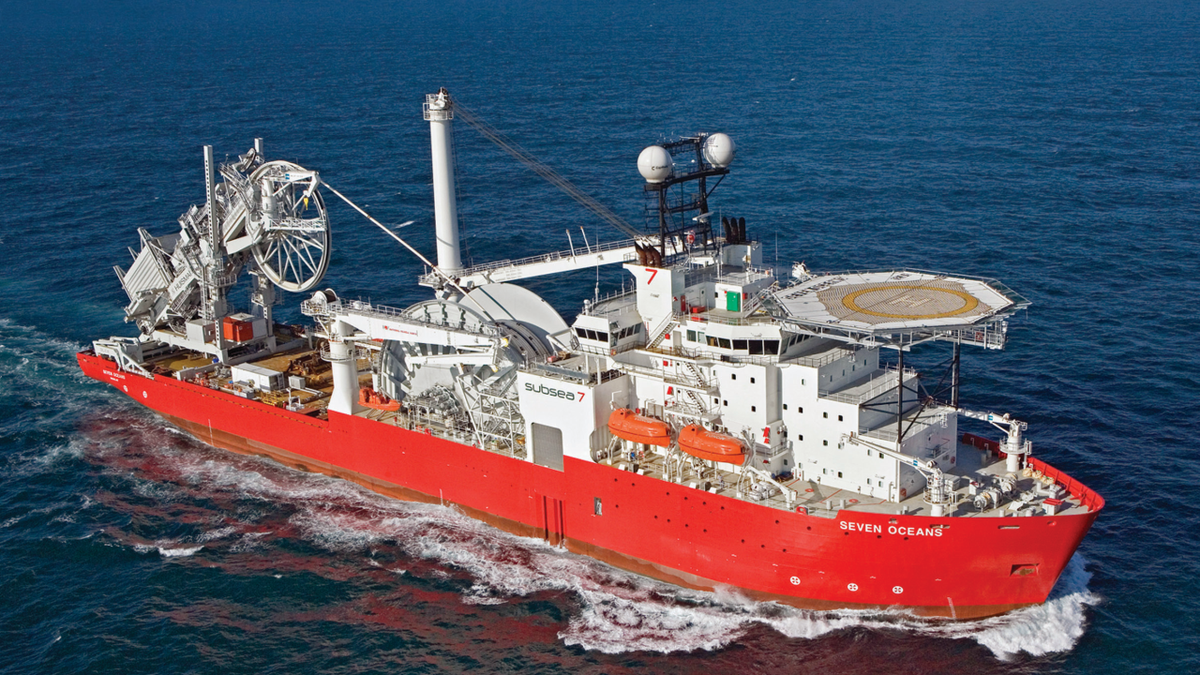
Image Source: Subsea 7
Yann Cottart, Senior Vice President of Brazil and Western Global Project Centers, commented: “This contract strengthens Subsea 7’s project portfolio in Brazil and consolidates the cooperative relationship we have established with Petrobras in pre-salt oilfields.”
The Sépia 2 oilfield is located approximately 280 kilometers southeast of Rio de Janeiro, with a water depth of 2,170 meters. As one of the largest expansion phases of Brazil’s pre-salt oilfields, it will play a key role in Brazil’s energy development. The contract scope includes the engineering, procurement, manufacturing, installation and pre-commissioning of subsea umbilicals, risers and flowlines for 17 wells (including 2 wells from the Sépia 1 project) and a gas export pipeline with 18 risers.
The phase undertaken by Subsea 7 uses a more advanced pipeline system designed to cope with the ultra-deepwater environment of 2,170 meters:
Rigid Risers & Flowlines: Approximately 144 kilometers of rigid risers adopt a Steel Lazy Wave Riser (SLWR) structure. The material uses Corrosion-Resistant Alloy (CRA) to meet the challenges of high pressure and potential corrosive media (such as high carbon dioxide content) in pre-salt oilfields.
Gas Export Line: A gas export trunk line supporting 18 risers, including 21 Rigid Jumpers and 20 Flexible Joints.
Sépia 2 will deploy the new FPSO P-85, which will be constructed in parallel with P-84 at the Atapu oilfield by Seatrium, with a contract value of approximately 8.16 billion US dollars. P-85 can process 225,000 barrels of crude oil and 10 million cubic meters of natural gas per day. It adopts an all-electric design, aiming to reduce greenhouse gas emissions per barrel of oil by 30%.
Tubing
On September 27, 2024, Petrobras signed a contract with Vallourec to supply Premium Oil Country Tubular Goods (OCTG), including seamless pipes, accessories and high-end connections. The steel grades include High Collapse, Sour Service and Super Martensitic, etc., which are suitable for complex pre-salt geological conditions (high temperature, high pressure, CO₂/H₂S content). They are mainly well pipes with sizes from 4.5 inches (4.5″) to 18 inches (18″) (specific sizes not fully disclosed), with a weight of 25,000 tons and a delivery period of three years. All products are from Vallourec’s factories in Brazil. In addition to product supply, it also includes Tubular Management Services, VAM Field Service and Vallourec’s complete set of digital solutions.
This contract is specifically aimed at the development needs of the two pre-salt projects, Sépia 2 and Atapu 2, supporting the drilling and completion of new wells and oil and gas production of these two projects.
On September 11, 2025, Vallourec also won a framework contract for overall offshore operations through a competitive public tender, supplying carbon steel and stainless steel pipes and related accessories, seamless pipes and VAM® premium connections, with pipe diameters ranging from 4.5 inches to 18 inches, mainly covering Petrobras’ offshore operation needs from 2026 to 2029. The maximum contract value can reach 1 billion US dollars. This is one of the largest OCTG contracts in terms of volume and revenue scale since Petrobras adopted the public tender model.
Sépia 1
Sépia 1 is located in Block BM-S-24 of the Santos Basin, belonging to a giant pre-salt oil and gas area, mainly centered on the FPSO Carioca MV30 production platform.
In October 2017, Petróleo Brasileiro S.A. (Petrobras) awarded the FPSO charter and operation contract.
MODEC (Mitsui Ocean Development Co., Ltd., Japan) is responsible for the EPCI (Engineering, Procurement, Construction, Installation) of the FPSO Carioca MV30 and the subsequent 21-year charter operation. The platform is converted from a Very Large Crude Carrier (VLCC), with a daily processing capacity of 180,000 barrels of crude oil and 6 million cubic meters of natural gas.
Tubing
In the Sépia 1 project (Sepia Phase 1), McDermott is responsible for the EPCI contract of subsea risers and flowlines. The contract scope includes rigid pipelines, jumpers, buoyancy modules, vortex-induced vibration suppression devices (strakes) and riser monitoring systems, which are used to connect 7 wells (3 production wells + 4 injection wells) to the FPSO Carioca MV30. The gas export trunk line (SEAP) mainly adopts thick-walled carbon steel pipes with a diameter of 18 inches and a length of approximately 128 to 131 kilometers. The specific supplier of pipes, pipe fittings or raw materials has not been disclosed.
Looking at the entire ultra-deepwater pre-salt oilfield development project of Sépia, from subsea pipeline and riser laying to FPSO platform supporting and well drilling and completion, extremely strict requirements are put forward for the performance of supporting steel pipes, pipe fittings, flanges and valves. As practitioners deeply engaged in the flange and pipe fitting industry, we can clearly see the huge market opportunities behind such world-class deep-sea energy projects. The project involves high pressure, high corrosion and ultra-deepwater extreme working conditions throughout the whole process. Whether it is pipeline connection, jumper supporting or oil and gas transmission pipeline docking, it is inseparable from the support of customized steel pipes, pipe fittings, flanges and valves with high strength, corrosion resistance and high sealing performance, which is also the core foundation for the stable operation of the entire subsea oil and gas pipeline network system. Compared with conventional onshore oil and gas projects, deep-sea pre-salt projects have almost harsh standards for product material selection, precision control and working condition adaptability, which also forces the industry to upgrade towards high-end customization, corrosion resistance and pressure resistance.
As a practitioner deeply engaged in the flange and pipe fitting industry, GMpiping has always focused on the supporting needs of deep-sea oil and gas projects, polished high-quality pipe fitting products that meet international marine engineering standards and adapt to complex ultra-deepwater working conditions, kept an eye on the supply chain needs of core strategic projects such as Brazil’s pre-salt oilfields, and strived to enter the supply chain system of the world’s top oil and gas development projects with stable product quality and perfect supporting services, seize opportunities and achieve win-win results in the wave of deep-sea energy development, and also contribute to the localization and global landing of high-end marine engineering pipe fittings.
Leave a Reply