
In the grand symphony of modern industry, flanges are the understated yet indispensable “joints”. Throughout a century, the development history of flanges is not only the iteration history of metal processing technology, but also a microcosm of human industrial civilization evolving from extensiveness to precision, and from experience to digital intelligence.
Century-old Axis: Technological Iteration from “Connection” to “Ultimate Sealing”
The birth of flanges stems from the urgent demand for fluid transportation during the Industrial Revolution. Its 100-year history can be divided into four key stages:
1. Empiricism and Casting Era (Late 19th Century – Early 20th Century)
Early industrial pipelines were mostly for low-pressure steam or water transportation. At this time, flanges were mostly made of gray cast iron through sand casting.
Technical Features: Rough sealing surfaces, with connections mainly relying on thick packing gaskets.
Milestone: In 1914, the American Society of Mechanical Engineers (ASME) began attempting to standardize flange dimensions. Before that, flanges produced by different factories were almost incompatible, making maintenance a disaster.
2. Rise of Forging and Establishment of Standardization (1930s – 1960s)
With the emergence of petrochemical industry and high-pressure boilers, the defects of cast iron parts—brittleness and easy sand holes—were fully exposed.
Technological Breakthrough: Die forging and open die forging processes entered the field of flange manufacturing. The forging process improved the internal structure of metals, significantly enhancing tensile strength and fatigue life.
Product Evolution: Weld Neck (WN) flanges became the standard configuration for high-pressure working conditions. Meanwhile, the introduction of stainless steel solved the problem of acid corrosion in petroleum refining.
3. Precision Machining and Explosion of Materials Science (1970s – 1990s)
The post-World War II industrial boom drove flanges towards large-scale and precision development.
Technological Iteration: The popularization of Computer Numerical Control (CNC) machines enabled the serrated finish of flange sealing surfaces to reach micron-level precision. Combined with spiral wound gaskets, it achieved a true “high-pressure sealing”.
Material Expansion: The maturity of duplex stainless steel, ultra-low carbon stainless steel and other materials allowed flanges to serve in extreme environments such as geothermal and deep sea for decades without corrosion.
4. Digital Intelligence and Extreme Working Condition Era (21st Century to Present)
The 2025 China Flange Industry Market Research Analysis and Development Trend Judgment Report points out that “modern flanges have integrated materials science, fluid mechanics, structural mechanics and digital technology, becoming the intelligent connection hub of industrial pipeline systems”.
Cutting-edge Technology: Finite Element Analysis (FEA) is used to simulate the creep behavior of flanges under drastic temperature changes (deep-sea oil and gas pipelines: high pressure + seabed temperature gradient; FEA simulates the creep behavior of flanges under thermal cycle + external load to ensure the safety of subsea pipeline connections). 3D simulation forging technology (such as DEFORM software) has achieved the ultimate optimization of material utilization.
Industry Trend: Green forging and online monitoring technology (smart bolts) have begun to emerge, and flanges are moving towards the goal of “zero leakage and maintenance-free”.
Shining Stars: Benchmark Enterprises with Historical Heritage and Modern Competition
The global pattern of the flange industry presents a vivid picture of “European brands setting standards and Chinese enterprises expanding scale”.
1. European Powerhouses: Gatekeepers of Craftsmanship and Brand
Galperti (Italy): A Century-Old Family’s Global Layout
Known as the “Rolls-Royce” in the flange industry, Galperti represents the top level of European forging industry. Its core competitiveness lies in the integration of the entire industrial chain: from its own steelmaking plant to ultra-large ring rolling equipment. It can manufacture giant flanges with a diameter of more than 5 meters for offshore wind power bases. For global oil giants (BP, Shell), Galperti is synonymous with safety and reliability. Galperti has participated in many major projects, such as providing high-pressure flanges, special forgings, and insulation joints (G-Joint®) for the FPSO upper modules and subsea pipeline systems of operators such as Petróleo Brasileiro S.A. (Petrobras) and Galp, and also participated in the supply of high-pressure pipe fittings, flanges and transition pieces for the FLNG hull and upper modules of the Indonesia Abadi LNG Project (Inpex).
Wilhelm Geldbach (Germany): Embodiment of Rigorous Standards
German enterprises have absolute right to speak in the formulation of DIN standards (German standards). The heat treatment control in its production process is a textbook example, ensuring the impact toughness of flanges in ultra-low temperature environments (such as liquefied natural gas, LNG), which is a technical moat that mid-to-low-end products cannot match. Wilhelm Geldbach participated in Germany’s national hydrogen core network (H2Core) project, providing hydrogen-specific flanges, insulation joints, and high-pressure pipe fittings for the German hydrogen trunk pipeline (such as FGL702) constructed by Salzgitter, Ontras Gastransport, etc., adapting to 700bar working conditions, and also participated in the Nordic Baltic Pipe project, providing high-pressure flanges, special pipe fittings, and insulation joints for the natural gas subsea pipeline connecting Denmark and Poland.
2. Chinese Strength: From “Iron Forging Township” to “Global Base”
Dingxiang Cluster (Shanxi): Transformation of Hidden Champions
Dingxiang, Shanxi, is the world’s largest flange production base. Starting from workshops with “every household having a furnace and emitting smoke” in the early days, it has now emerged as modern enterprises such as Hengrui Forging and Baohang Heavy Industry.
Core Competitiveness: An extremely complete supply chain supporting system. In Dingxiang, the whole process from blanking, forging, heat treatment to precision machining can be completed within a 5-kilometer radius. Through digital and intelligent transformation, Dingxiang flanges have accounted for more than half of the global onshore wind power flanges, realizing a qualitative change from “selling by weight” to “selling by piece”.
Jiangyin Fangyuan Ring Forging: Deeply Cultivating the Blue Ocean of Wind Power Flanges
As a representative of China’s high-end ring flange, Fangyuan Ring Forging has solved the problem of easy deformation of extra-large diameter flanges by using large-scale CNC ring rolling machine technology. Its products are widely used in nuclear power plants and offshore giant wind turbines, representing the highest competitiveness of Chinese flanges in vertical segmented fields.
Industry Overview: In-depth Deconstruction of Enterprises’ Core Competitiveness
In the fierce market competition, an excellent flange enterprise must have the following four dimensions of capabilities:
1. Material Customization and Heat Treatment Capability
The core of high-end flanges lies not in “shape” but in “performance”. Whoever can master the forging and heat treatment of nickel-based alloys (Inconel 600 (UNS N06600), Inconel 601 (UNS N06601), Inconel 625 (UNS N06625)), Hastelloy (Hastelloy C-276 (UNS N10276), Hastelloy C-22 (UNS N06022), Hastelloy B-2 / B-3 (UNS N10665 / N10675)) or special duplex steel (2205 (S31803 / F51), 2507 (S32750 / F53), S32760 (F55)) will have an access permit to enter blue ocean markets such as nuclear power and aerospace.
2. Geometric Accuracy and Surface Integrity
In harsh hydrogen transportation (as mentioned earlier, the core process of hydrogen transportation must prevent hydrogen embrittlement and must simulate penetration through helium leak test) or vacuum environments, the flatness requirements of flange sealing surfaces are extremely high. Excellent enterprises ensure airtight connection without adding excessive sealant through high-precision CNC grinding technology.
3. Digital Quality Traceability System
For high-risk scenarios such as offshore oil platforms, each flange must be traceable. From the ingot heat number, the instantaneous temperature during forging to the cooling rate curve of heat treatment. Enterprises with full-life-cycle digital files are more likely to gain the trust of international large-scale engineering EPC contractors.
4. Flexible Manufacturing and Quick Response Capability
Modern projects often involve a large number of non-standard parts. Whether an enterprise has strong engineering design capabilities (such as the rapid design of API 6A high-pressure wellhead flanges) determines its ability to gain a foothold in the high-value-added customized market.
Future Outlook: Green, Intelligent and Extreme Challenges
The flange industry is standing at a new crossroads.
Energy Transition: The hydrogen economy poses a new challenge of “hydrogen embrittlement” protection for flanges. In the future, hydrogen permeation-resistant coatings and special alloy flanges will become the focus of research and development.
Carbon Neutrality Pressure (as mentioned earlier, China, the European Union and other countries have formulated mandatory emission reduction clauses): Traditional forging is a high-energy-consuming industry. The adoption of net shape manufacturing technology and induction heating instead of gas furnaces will become the key for enterprises to obtain green financial support.
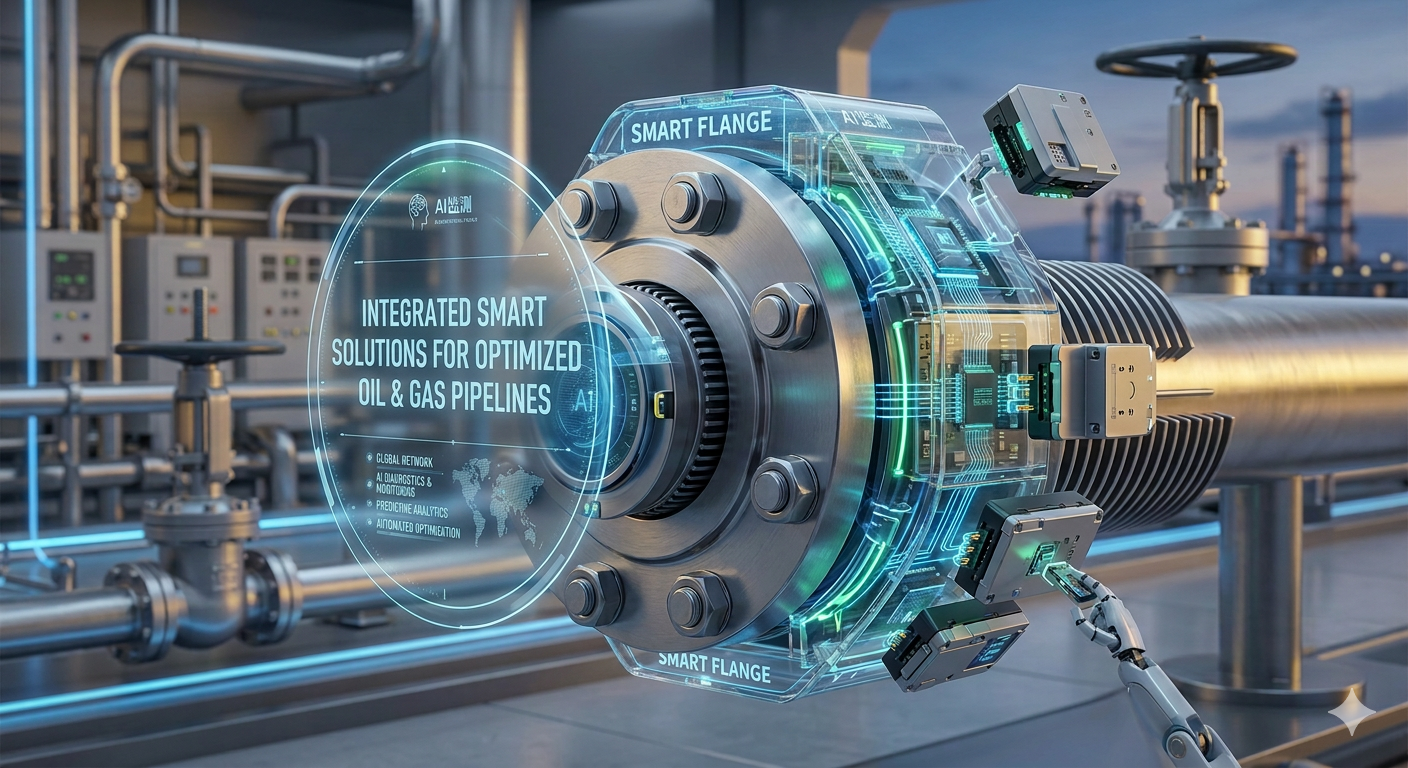
Intelligent Monitoring: Future flanges will no longer be “inert objects”. Smart flanges embedded with sensors can real-time perceive pipeline pressure fluctuations and bolt loosening, realizing the leap from passive maintenance to predictive maintenance.
BNANGUO, the intelligent AI system under GM Piping, is building a global supply chain big data platform covering flanges, pipe fittings, valves and other full-category products, realizing full-process data interconnection and intelligent management and control from raw materials, production, logistics and transportation to engineering applications. Relying on the full-process digital monitoring from design, manufacturing to on-site service, in the near future, BNANGUO, through smart flanges equipped with embedded sensors, can real-time perceive pipeline pressure fluctuations, bolt loosening, and even minor cracks and wear and other early hidden dangers, accurately capturing the health status of equipment.
With strong data computing power and global optimization capabilities, the system can dynamically match the optimal resources for customers, provide integrated supply chain services with the best cost performance, the shortest delivery period, and the most reliable quality and safety, promoting the industry to leap from passive maintenance to predictive maintenance, and then to full-life-cycle precise renewal, creating a more intelligent, efficient and safe new ecosystem of pipeline systems for the energy, chemical, LNG and high-end equipment fields.
This innovation completely breaks the traditional operation and maintenance model, promotes the industry towards full-cycle health management and precise regular renewal, and provides a one-stop solution for safe, efficient and intelligent pipeline systems in the energy, chemical, LNG and high-end equipment fields.
Leave a Reply